
Zavala Release Dates Explained
“Release date” can name several different events in a Zavala County case. A judge may sign an order, bond may post, jail staff may close the booking, and the person may leave the building at different times. A transfer date ends Zavala County Jail custody but begins custody with another agency. In the state system, parole eligibility, a board vote, a release certificate, and physical departure are also distinct. Each date should retain its own label.
A projected date is a forecast. TDCJ describes its Projected Release Date as the date calculated by its Classification and Records Office for a person to leave incarceration if parole does not occur sooner. Offense law, sentence data, credits, mandatory-supervision eligibility, and later decisions shape that forecast. An actual release date records an event that has occurred. A court order or favorable parole vote authorizes or advances a process, but it does not by itself prove that the person crossed the gate.
Scheduled versus actual. Treat a projected date, parole vote, or signed order as a milestone. Confirm physical release or transfer through the custodian's event record.
Pretrial detention works differently. An unsentenced person has no sentence-based projected release date. Bond, dismissal, a judicial order, unresolved warrants, and detainers may decide whether and when the person leaves. Even after release authority exists, identity checks, record processing, transport, or another agency's hold can delay departure. Ask what the timestamp means rather than calling every listed date “the release date.”
Find Zavala Projected Release Dates
The first lookup step is to identify whether the person is in the Zavala County Jail, a TDCJ facility elsewhere in Texas, or another system. No operating TDCJ unit was identified inside Zavala County. A felony case from the county can still lead to state imprisonment at a unit assigned by TDCJ. Use a full name plus a stronger identifier such as date of birth, booking number, SID, or seven-digit TDCJ number whenever possible.
- Fix identity and custody. Gather the booked name, aliases, date of birth, court or cause number, booking number, SID, or TDCJ number. Do not merge similar names.
- For a current state prisoner, search TDCJ. Use the TDCJ Inmate Search by TDCJ number, SID, or last name plus at least a first initial. Open the details record and read its exact Projected Release Date label.
- For a county sentence, call the jail. The Zavala County Jail line is 830-374-3105. Ask for the sheriff's release computation and which credits or orders were applied.
- Read the court record. Obtain the judgment, sentence, jail-time credit, commitment, later orders, and any release or discharge instrument from the proper Zavala clerk.
- Confirm the current stage. If parole review is involved, check the vote and then the post-vote release channel. If the person has left custody, request the release or transfer record.
The public TDCJ search is limited to people currently incarcerated in a TDCJ facility. It updates on working days, and its information is at least 24 hours old. Once someone leaves TDCJ, the former public result may disappear. That negative search does not prove discharge. TDCJ's telephone, email, public-information, release, parole, and IVSS channels must carry the inquiry forward. The official TDCJ search screen shows the fields and scope that govern a state-prison lookup.
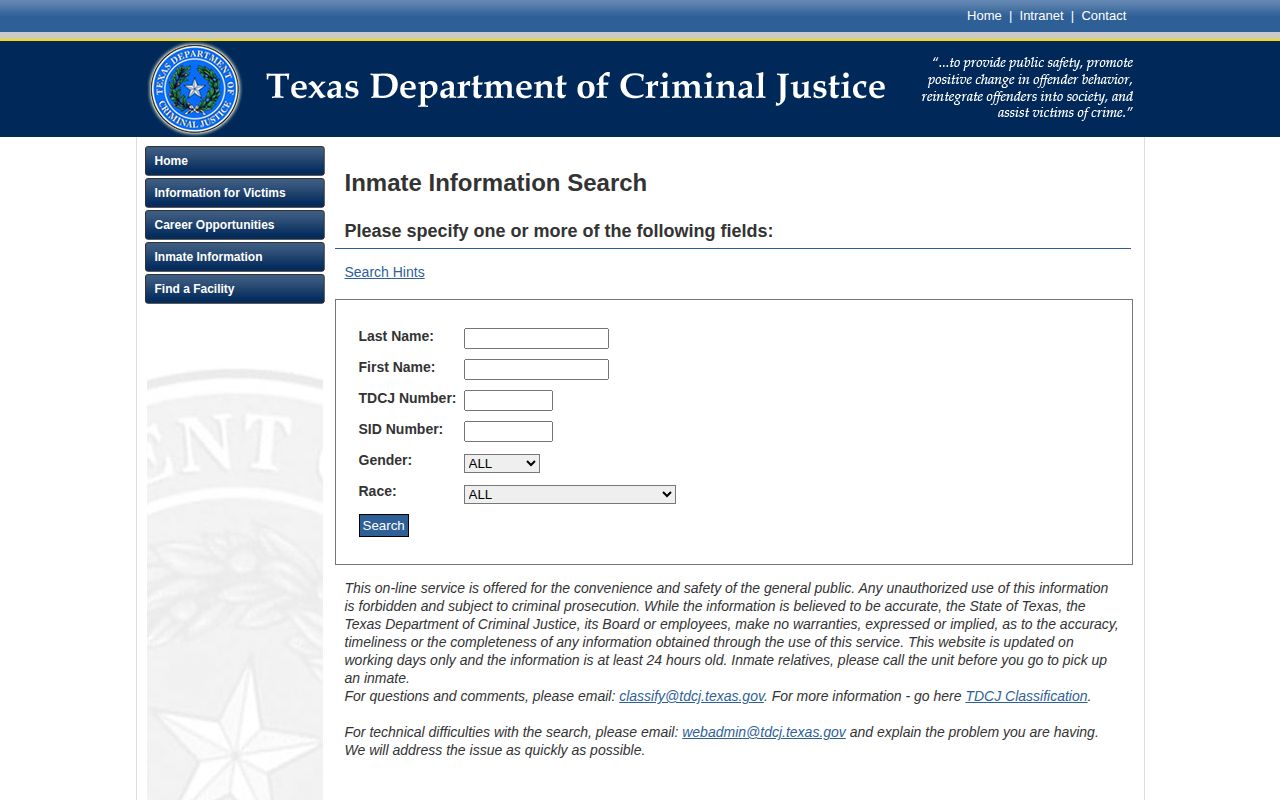
That screen is useful for a current state prisoner, but Zavala County jail computations and past TDCJ release records require other channels.
Note: A missing current TDCJ result proves only that no matching current incarceration record appeared in that search.
Zavala Release Calculation Channels
Zavala County and TDCJ do not calculate dates through the same office or record. The county jail applies its records and the controlling court papers to a local term. TDCJ applies state classification, sentence, credit, eligibility, and board data to imprisonment in its system. A date copied from the wrong channel can be accurate for one stage and useless for another. The official page for Sheriff Eusevio Salinas supplies the county jail contact, while the District Clerk page supplies the district-court record route.
| Custody or status | Calculation source | Best confirmation |
|---|---|---|
| Pretrial in Zavala County | No sentence projection; bond, court orders, warrants, and holds control | Jail status plus the signed court instrument |
| Serving a county-jail term | Sheriff computation using judgment, jail credit, local credits if any, and later orders | Jail release computation and booking-out record |
| Currently in TDCJ | TDCJ Classification and Records calculation | Projected Release Date field plus TDCJ information channels |
| Approved for parole | BPP vote followed by TDCJ Review and Release Processing | Post-vote release status, certificate, and actual release record |
| Already out of TDCJ | Historical incarceration and release record | TDCJ records, parole status, IVSS notice, or release certificate |
No Zavala-specific public good-time policy or weekend-release rule was found in the reviewed sources. That absence matters. Any generic estimate would have to guess about credits, stacked or concurrent terms, offense findings, detainers, and local practice. Use the actual judgment and custodian's computation instead.
Texas Good Time Rules
Texas Government Code Chapter 498 governs good conduct time in TDCJ. Section 498.003 addresses classifications and credits, while Section 498.004 addresses forfeiture and restoration. Good time is not a vested right. It does not simply erase part of the sentence imposed by the court. It affects eligibility and calculations only as Texas parole and mandatory-supervision law permits.
Texas has no general 85-percent truth-in-sentencing rule. Federal shorthand should not be imported into a Zavala release date. Government Code Chapter 508 uses offense-specific and date-specific formulas. Section 508.145 includes different rules for listed offenses, deadly-weapon findings, other cases, life terms, and special categories. One commonly encountered provision requires actual calendar time equal to one-half of the sentence or 30 years, whichever is less, for its covered category. Another uses actual time plus good time equal to one-fourth of the sentence or 15 years, whichever is less. Those are eligibility formulas, not promised departure dates.
Mandatory supervision adds another layer. Section 508.149 lists exclusions. Eligible offenses committed before September 1, 1996 follow an older calculation in which flat time plus good time can reach the scheduled date. For an eligible offense on or after that date, discretionary mandatory supervision also requires panel approval. A denial can move the projection toward maximum expiration. Later approval or another lawful recalculation can move it again.
- Flat time
- Calendar time actually served.
- Good time
- TDCJ credit that may affect eligibility or a calculation under governing law.
- Parole eligibility
- The point at which BPP may consider release, not a right to release.
- Mandatory supervision
- A statutory release process subject to eligibility rules and, for many later offenses, panel review.
- Maximum expiration
- The sentence end point after lawful sentence and credit calculations.
Why Zavala Release Dates Change
A Zavala-connected state prison date can move before the person leaves. Some changes affect the calculation. Others delay release after a favorable decision. The record should say which occurred. Compare the newest official entry with the older one, preserve both access dates, and avoid replacing a prior milestone with a later event as though they meant the same thing.
| Factor | Possible effect | Record to check |
|---|---|---|
| Credit earning, loss, or restoration | Changes a lawful eligibility or projected-date calculation | TDCJ time-credit and disciplinary record |
| Offense or sentence correction | Changes the data used to calculate the date | Judgment, mandate, and TDCJ classification record |
| Mandatory-supervision decision | Approval may permit release; denial may move the projection | BPP decision and TDCJ details |
| Parole vote | May permit release sooner, require a program, or deny release | Current BPP vote code and release processing status |
| Detainer or another warrant | May block community release or cause transfer | Jail or TDCJ hold and receiving-agency record |
| Release plan or certificate work | May delay the gate event after a favorable vote | TDCJ Review and Release Processing status |
Offense dates matter because Texas law changes over time. So do deadly-weapon findings, listed exclusions, concurrent or stacked sentences, later court orders, and required programs. The official BPP handbook and current statutes should be read with the judgment. A one-line estimate cannot safely combine those facts.
Zavala Parole Release Milestones
Families sometimes hear that a person “made parole.” That phrase may refer to eligibility, file review, a favorable vote, completion of a required program, issuance of a release certificate, or actual release. Texas panels generally review files individually rather than holding an ordinary public hearing for every person. A public inmate hearing calendar should not be expected.
TDCJ says cases are generally identified before eligibility, then a three-member panel reviews the file and two votes decide. Current vote codes must be read on the BPP vote-options page. FI-1 is not the same as program-conditioned FI-3R or FI-6. Review and Release Processing may still need to check the residence plan, county, programs, conditions, disciplinary facts, and certificate. Approval can also be withdrawn based on new information.
Before a vote, the official status line is 844-512-0461. After a release vote, the TDCJ Parole Division release-status line is 512-406-5202. Once physical release is confirmed, the Del Rio District Parole Office serves Zavala County parole and mandatory-supervision cases. County probation remains a separate court-run channel. The site's Post-Release Supervision page explains that local split.
Note: A favorable parole vote predicts a later process step, while the release record proves the actual custody event.
Confirm Zavala Actual Release Dates
For TDCJ information, call 936-295-6371 or 800-535-0283 during the published weekday information hours. An exact date of birth is needed when no TDCJ or SID number is known. TDCJ's inmate-information email channel can provide incarceration history and a Projected Release Date when supplied with the required identifiers. A formal public-information request is the stronger route for a release certificate, discharge history, or document copy.
For Zavala County Jail, call 830-374-3105, then follow the county Open Records instructions for a written “Public Information Request.” Ask for the jail-register entry, booking-out sheet, release or transfer order, exact date and time, disposition, and receiving agency. Request existing records rather than asking staff to create a calculation report.
Use Texas IVSS as an alert aid, not the official date record. County events belong in IVSS-Counties when participating data are available, while state-prison events use the separate TDCJ IVSS system. A notice should prompt a call and record request. When sources disagree, label each date by function and prefer the custodian's event record for physical custody and the signed court paper for judicial action. The TDCJ definitions page is the source for the state's calculation terms and date distinctions.
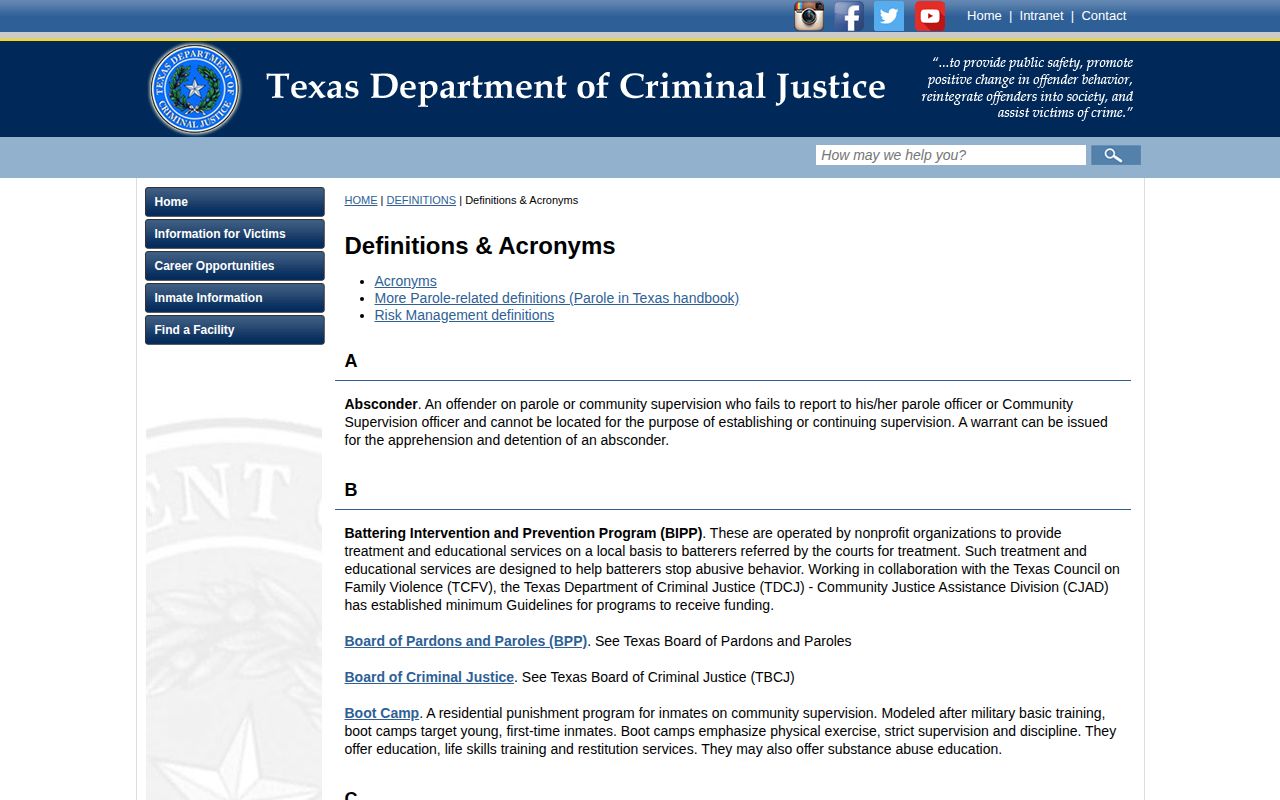
Those definitions help interpret a displayed projection, but the newest official release or transfer record remains the proof of what happened.