
TDCJ Statewide Release Paths
No operating TDCJ prison or state jail was identified inside Zavala County. A person convicted in a Zavala court can still enter state custody after transfer from the county jail and be assigned to a TDCJ facility elsewhere in Texas. The county of conviction does not identify the prison location. It also does not prove where the person went after release.
A state-prison departure may be parole, mandatory supervision, discharge at maximum expiration, or a transfer. Parole is discretionary release into TDCJ supervision. Mandatory supervision is a statutory release path that may also require a board decision depending on the offense date and eligibility. Discharge means the state sentence or supervision obligation reached its recorded end. A transfer simply moves custody.
The state release record should name the event and date. For a person on parole or mandatory supervision with a Zavala connection, TDCJ assigns the county to the Del Rio District Parole Office in Region IV. A full discharge may leave no active parole supervision. A county probation order belongs to the court and local probation department, not to TDCJ Parole Division.
Search Current TDCJ Custody
The TDCJ Inmate Search is a current-custody locator, not an archive of released people. Search by TDCJ number, SID number, or last name with at least a first initial. A live detail record can show assigned location, offenses, Projected Release Date, and parole-review information. The data update on working days and are at least 24 hours old.
- Use the seven-digit TDCJ number or SID when available because an identifier is stronger than a name.
- Otherwise enter the exact last name and at least the first initial, then test documented name variations if needed.
- Compare the result with date of birth, conviction county and court, offense, and any earlier custody document.
- Save the exact status and access date without translating a projected date into a guaranteed release.
- Move to TDCJ information or public records when the person is no longer included.
The official search screen shown below states the current-incarceration scope. That limit explains why a person can disappear after state release.
Review the official TDCJ search fields and current-custody notice.
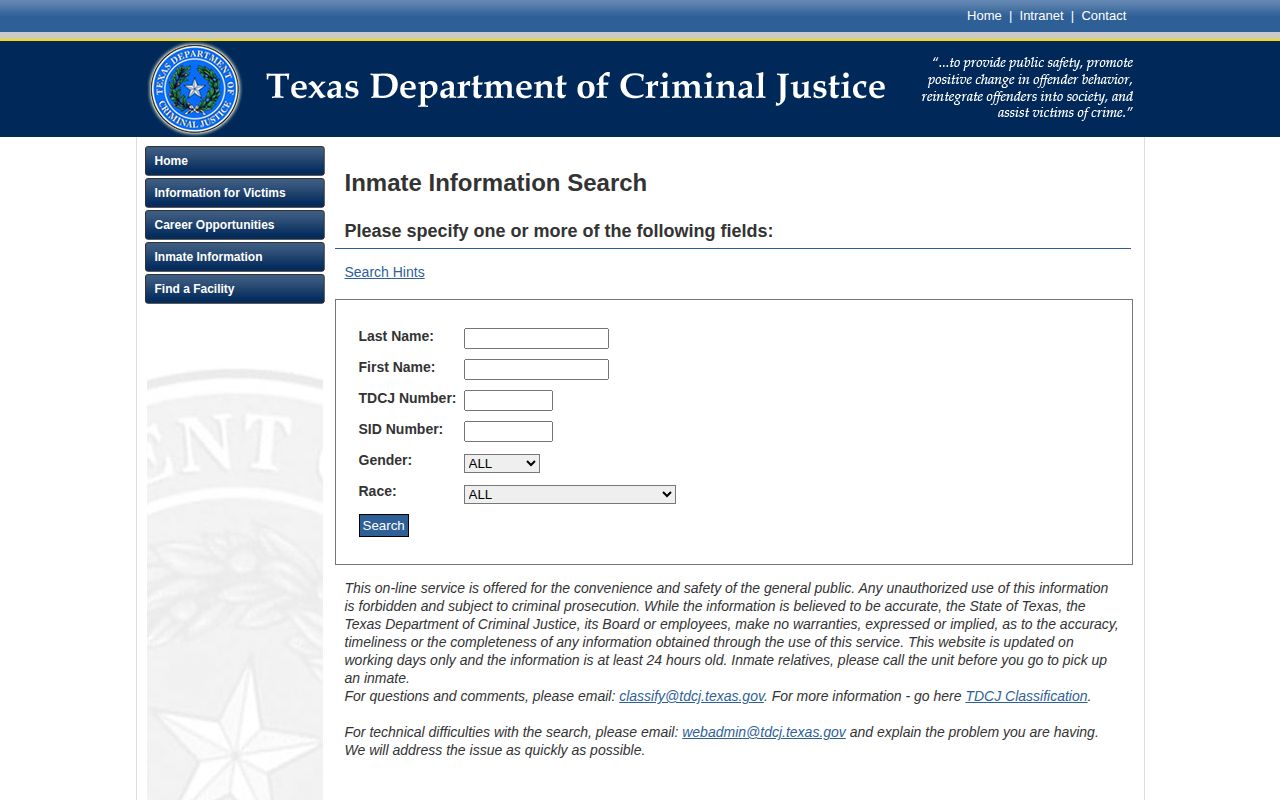
A missing current result is not a discharge certificate. It proves only that the search did not return a matching currently incarcerated person under the inputs used.
Confirm a Past TDCJ Release
Begin with identifiers from the judgment, Zavala County Jail transfer, or older TDCJ record: full name, date of birth, SID, seven-digit TDCJ number, conviction court and county, sentence, and approximate dates. Then ask TDCJ for incarceration history, release or discharge date, and the event type. Do not describe a missing live-search record as proof of release.
The TDCJ general locator lines are 936-295-6371 and 800-535-0283 during published weekday information-office hours. Exact date of birth is required if the TDCJ or SID number is unknown. TDCJ also accepts inmate-information questions through pia@tdcj.texas.gov. Its information page asks for full name and TDCJ number, or exact birth date or approximate age plus county of conviction when the number is unavailable.
That ordinary information service can supply incarceration history, offense and court data, current incarceration, and a Projected Release Date. It does not supply photographs through the email route. For a formal release certificate, discharge history, or releasable institutional image, use the TDCJ public-information process and ask for existing records. Request segregable public portions if some information is withheld.
Note: State the system-specific result accurately, including the search date, identity inputs, and TDCJ's current-incarceration limitation.
TDCJ Release Records and Contact
A narrow public-information request can seek the person's admission and release history, release type, release certificate or history, and any releasable department photograph. Identify the person by full name, TDCJ number, SID, date of birth, Zavala conviction court or county, and approximate dates. State that the request seeks existing records.
TDCJ Public Information RequestP.O. Box 4017
Huntsville, TX 77342
Email: PIA@tdcj.texas.gov
General locator: 936-295-6371 or 800-535-0283
The TDCJ open-records page provides the current submission routes. Use the formal process for document copies. Do not include a Social Security number or other irrelevant sensitive data.
The official TDCJ telephone-information page shown below is the matching source for state status and release lines. Check it before calling.
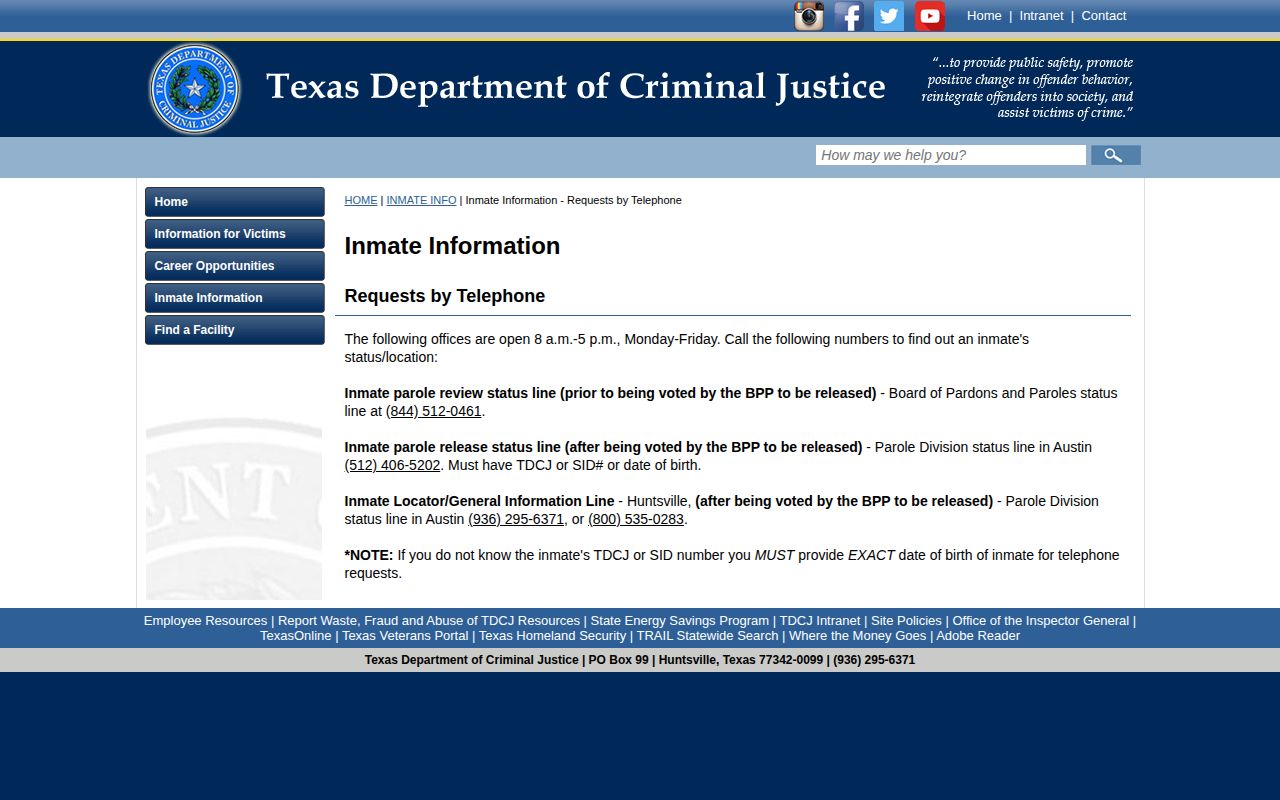
The page helps route a current question, while a written response provides the more durable state release record.
TDCJ Projected and Actual Release
The exact TDCJ field is Projected Release Date. It is a forecast calculated by the Classification and Records Office for when an incarcerated person may leave if not paroled sooner. It is not a gate appointment. Offense date and title, sentence, accrued good time, mandatory-supervision eligibility, board action, disciplinary forfeiture, detainers, and other lawful recalculations can change the result.
| Date or event | Meaning |
|---|---|
| Parole eligibility | The board may consider release; eligibility does not guarantee approval. |
| Board vote | A decision milestone that may carry programs, conditions, or later processing. |
| Projected Release Date | TDCJ's current forecast under the applicable sentence and release rules. |
| Release certificate or history | Official evidence of the release type and effective state event. |
| Maximum expiration | The recorded sentence end when earlier release does not control. |
Texas has no blanket 85-percent rule. Government Code Chapter 498 governs good conduct time, including awards and forfeiture. Chapter 508 contains offense- and date-specific parole and mandatory-supervision rules. Good time is not a vested right and does not automatically shorten the court's sentence. A generic percentage or sentence calculator cannot account for the required case facts.
The county jail does not compute its sentence dates through the TDCJ field. For a local jail term, obtain the judgment, time-served calculation, commitment, and sheriff's computation. No Zavala-specific public good-time policy or weekend-release rule was located.
TDCJ Parole Release Verification
A favorable parole vote is not proof of physical release. Texas panels generally review files rather than holding an ordinary public hearing for each person. Review and Release Processing may still need to resolve required programs, residence plans, special conditions, disciplinary issues, and certificate work. The vote date, certificate date, and actual release date can differ.
Before a board vote, the parole-review status line is 844-512-0461. After a release vote, TDCJ Parole Division's release-status line is 512-406-5202. Provide the TDCJ or SID number, or the requested identity information. Read the exact current vote code on the BPP vote-options page. FI-1 is not interchangeable with a program-conditioned approval, and an approval can later be withdrawn.
After physical release, the Del Rio District Parole Office is the assigned TDCJ supervision contact for Zavala County. It is at 903 E. 12th Street, Del Rio, Texas 78840, and the published phone is 830-775-4516. Office staff may limit disclosure. A full discharge may mean there is no active parole supervision to verify.
Texas IVSS for state prisoners is separate from IVSS-Counties. A state notification can prompt confirmation, but the TDCJ record remains the official source for the release event.
Zavala Conviction Versus TDCJ Location
A TDCJ statistical table can group releases by county of conviction without identifying where a person was imprisoned or released. TDCJ's fiscal-year report counted 16 releases associated with Zavala as county of conviction, divided among prison, state-jail, and substance-abuse-felony-punishment categories. That figure is not a Zavala County Jail release count, does not mean the releases occurred inside Zavala County, and does not prove that the people returned there.
Use the conviction court as an identity and sentence link. The Zavala District Clerk can route district-court judgments that establish the offense, sentence, time-served entry, and commitment. TDCJ records then establish the institutional sequence and state departure. The county jail transfer record bridges the local booking to state custody. The official page for Sheriff Eusevio Salinas supplies the current sheriff contacts, and the county Open Records route supports a request for an existing local transfer record. Together, those sources explain more than a current TDCJ result alone.
The former Crystal City Correctional Center is also not a TDCJ unit. It closed in 2012 and appears only as a historical contract-facility issue. A present state-prison inquiry should never be routed to its old address. No active TDCJ facility was identified in Zavala County.
Separate TDCJ From Other Custody
A person who disappears from Zavala County Jail may have gone to TDCJ, but the destination field must say so. Another county, ICE, or USMS requires a different search. A transfer to ICE can be checked through ODLS, which covers current detention and only a limited recent-release window. USMS has no public released-person locator. BOP covers federal prisoners and may show Released or Not in BOP Custody.
A BOP release proves departure from federal BOP custody, not departure from TDCJ or completion of federal supervision. An ICE release result is limited to that immigration system. A TDCJ non-result is limited by the current-incarceration scope. Each system should be reported in its own terms, without turning one negative search into a claim about all custody.
For someone whose last known event was at Zavala County Jail, first obtain the local release or transfer record and its receiving-agency field. The Zavala County Jail release page covers that county process. Move to TDCJ only when a judgment, transfer record, older state identifier, or another reliable source supports the state-custody branch.
Note: Preserve each agency's exact status language, since no single county, state, federal, or immigration search can rule on every custody system.