
No Official Zavala 72-Hour Feed
No official Zavala County 72-hour release view was located on the sheriff or county pages reviewed. It is not a longer setting hidden inside a county roster. No official roster, recent-release archive, web-retention period, booking-photo field, or update cadence was found either. The official page for Sheriff Eusevio Salinas offers local contact information, but not a three-day list.
That absence changes the workflow. Start with the jail at 830-374-3105 when a current answer is needed. Ask whether the person is still in Zavala custody. When looking across all departures during three days, submit a written request for existing entries bounded by exact timestamps. The sheriff line at 830-374-3615 is another contact route, but a phone answer should be followed by records when the precise event or destination must be preserved.
The official Zavala County Sheriff page captured below is the matching source for the finding. It supports the contact route and shows why no local 72-hour fields can be described as web results.
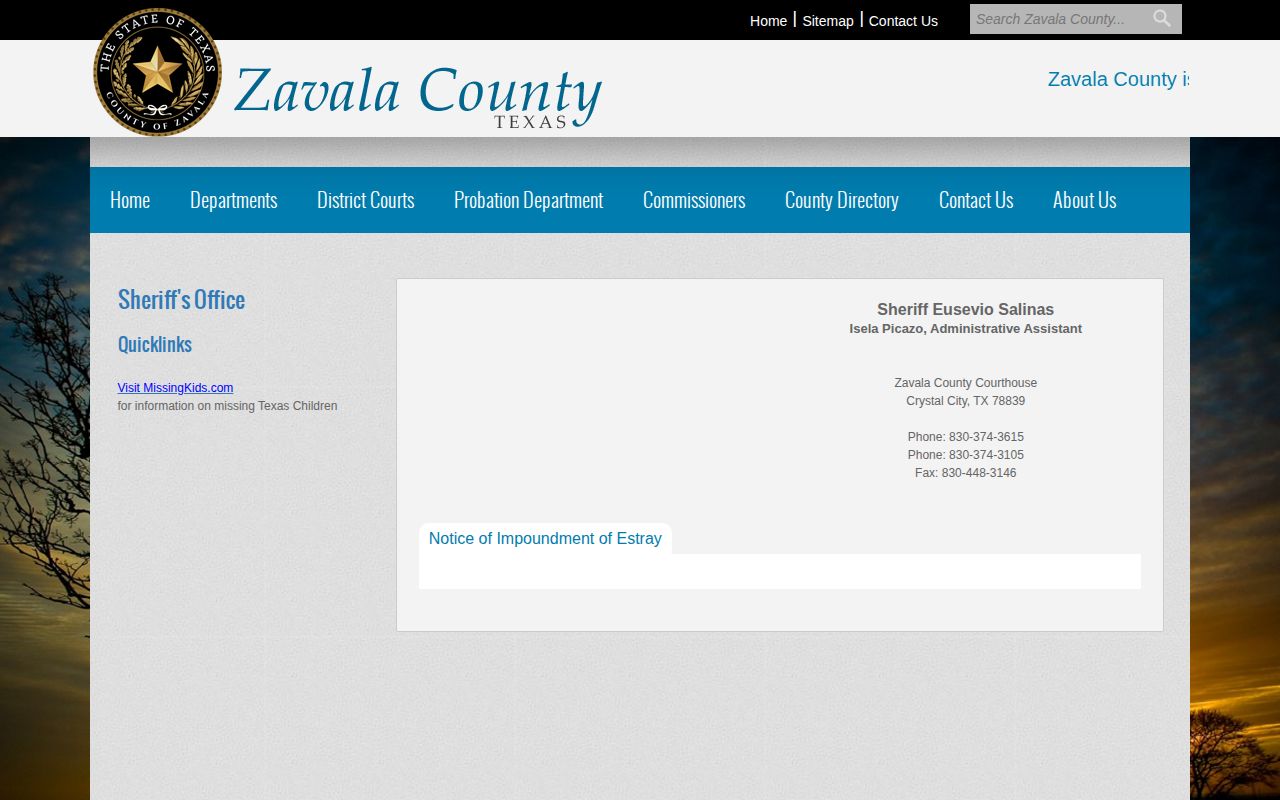
The county page provides an official starting point, not a rolling list of released or transferred people.
Request Zavala 72-Hour Releases
Define the three-day window before contacting Open Records. Use exact beginning and ending timestamps in Central Time. A phrase such as “over the weekend” can be read in several ways, while a fixed interval gives the custodian a clear search boundary. Ask for people released or transferred during that span. Including transfers prevents the response from hiding a major type of local departure.
- Head the submission Public Information Request and provide full requester contact details.
- State the exact 72-hour start and end in Central Time, including both date and clock time.
- Request an existing jail report or database export if maintained, or responsive jail-register entries if no compiled report exists.
- Name the core fields: booking number, booked name, event timestamp, disposition, and receiving agency.
- Ask for electronic copies and segregable public portions, then send the request through the county's published email or mailing route.
The Zavala County public-information instructions give judge@zavalacounty.gov and Attention: Open Records, 200 E. Uvalde St., Suite 9, Crystal City, TX 78839. The request should describe records already in existence. It should not demand that the county design a “72-hour webpage,” calculate conclusions, or explain each person's legal situation.
If the county does not keep a compiled three-day report, ask for the responsive entries in the form maintained. A narrow person-specific request can be more practical if only one booking matters. Texas public-information rules allow exceptions and redactions, so request any segregable portions that can be released. No Zavala-specific jail fee schedule or guaranteed turnaround was found.
Zavala 72-Hour Release Fields
A useful three-day response does more than list names. It identifies the booking, places the departure inside the requested window, and records what happened next. These are request fields drawn from Zavala's release-record path, not claims about an online display. Ask staff whether the timestamp is a system entry, booking closeout, transfer, or physical departure time.
| Requested field | Reason it matters across three days |
|---|---|
| Full booked name | Supports identity matching while preserving the spelling used by the jail. |
| Booking number | Separates two jail stays or people with similar names. |
| Release or transfer timestamp | Determines whether the event falls inside the defined 72-hour interval. |
| Disposition or release type | Distinguishes bond, time served, sentence completion, court order, and transfer. |
| Charges and bond disposition | Connects the jail event to the proper case and possible release authority. |
| Receiving agency or destination | Shows whether custody continued with TDCJ, ICE, USMS, another jail, or another system. |
Request a court or cause number when available. The court record explains the legal authority, while the jail record answers physical custody. Those two records can carry different dates without either being wrong. A booking photo is a separate item. If requested for each person in a broad three-day set, it may increase volume and cost. Specify whether releasable photos are actually sought.
Weekend Zavala Release Windows
A 72-hour interval is useful when an inquiry spans a weekend, holiday, or several missed checks. It can capture events that fall outside one calendar day. Zavala County, however, publishes no weekend release policy, holiday schedule, gate hours, or fixed processing time. Do not assume that a signed order produces immediate physical departure or that an event will be recorded on the same date as the court action.
Several tasks may sit between release authority and departure. Staff may need to check identity, other warrants, detainers, transport, and property closeout. A transfer may also depend on the receiving agency. When a three-day response contains more than one date, label each date instead of selecting the one that looks most convenient. The order date, bond-posted date, booking-out date, transfer date, physical release date, and database entry time describe different events.
A three-day range is not automatically “the weekend.” For example, a request beginning late Friday ends late Monday, not at the end of Sunday. State each boundary and the Central Time zone. Preserve the county's date format in the response. If a source does not identify a time zone for a specific field, do not add one to quoted data.
Note: A wider window catches more events, but only exact boundaries reveal whether a disputed overnight release belongs inside the requested period.
Zavala 72-Hour Records Outlast Listings
Zavala's lack of a web archive does not mean release records vanish after three days. The Texas State Library Local Schedule PS treats the county jail register as permanent. Its minimum retained content includes the person's name, intake information, confinement basis, and release or transfer date. This permanent register is the durable backstop when there was never a rolling county page to save.
Other records have separate minimum periods. Booking-in and booking-out forms, along with commitment, transfer, or release orders, remain through release or transfer plus two years. Property inventories and receipts use that same period. Transfer documents have their own schedule. These rules help an older three-day inquiry, yet they do not compel web posting and do not override lawful confidentiality, expunction, or other access limits.
The distinction between an operational display and an official record is central. A roster, if one existed, would serve present operations. The jail register records the custody event. The booking-out sheet or order may add the type and detail needed to tell community release from transfer. Ask for all responsive sources when one terse register line does not resolve the question.
Reconcile Zavala Release Timestamps
Three days can contain overlapping records from the court, jail, and receiving agency. Compare definitions first. The signed court order proves judicial action. The jail closeout or release instrument proves the local custody event. A TDCJ, ICE, USMS, or other county record proves the next system's event. One source should not be stretched to answer another custodian's question.
Start with the booked identity and booking number. Compare date of birth only when needed to distinguish people, then use the cause number and agency identifiers. Similar names and ages are not enough to merge records. If two sources remain in conflict, state that identity or timing is unconfirmed. A precise account can say that an order was signed on one date and that the jail recorded departure later.
- Order date
- The date a court authorized a legal change, not always the time the jail doors opened.
- Booking-out time
- The jail's administrative closeout time, which may differ from physical departure.
- Transfer time
- The point at which another custodian accepted the person.
- Release date
- The date attributed to release by its source and definition, which should be named.
Trace Zavala Three-Day Transfers
“Released from Zavala County Jail” may mean the person left local control but remained confined. If the receiving field says TDCJ, the state inmate search can confirm current TDCJ incarceration. Its public results include only people currently held in a TDCJ facility and are at least 24 hours old. A missing result does not prove state discharge. Use TDCJ telephone or written information for incarceration and release history.
If the record says ICE, search the ICE Online Detainee Locator System with a nine-digit A-number and country of birth, or exact name and country of birth. ODLS covers current detainees and people released from ICE custody during the prior 60 days. That limited window is not a permanent history. The former Crystal City Correctional Center closed in 2012 and must not be treated as the current destination merely because it appears in old search results.
| Recorded outcome | Next verification source |
|---|---|
| Bond or court release | Jail departure record plus the signed bond or release order and current docket. |
| TDCJ transfer | TDCJ current search, then TDCJ information or records for later discharge history. |
| ICE transfer | ICE ODLS and agency records, using the county's receiving-agency entry. |
| Another county | The named receiving jail and its own records custodian. |
| USMS or federal | Federal court docket and agency records; USMS has no public released-person locator. |
Verify a Named Zavala Release
A countywide 72-hour request may be broader than necessary when the question concerns one person. Record the full booked name, any known alias, approximate booking dates, and booking number. Call the jail first. If staff confirms that the person is no longer there, ask for the departure time, disposition, and destination. Then request the booking-out sheet, jail-register entry, release or transfer order, and receiving-agency field.
For a same-day event, use the narrower Zavala County 24-hour releases method. For a named-person search that may branch to court, TDCJ, supervision, or federal records, use the Zavala County released inmates lookup. Both routes preserve the same rule: a current-roster absence ranks below the official release or transfer record.
Texas IVSS-Counties can be used as a notification aid when participating data are available. Search by full or partial name, DOC ID, SID, jail ID, or permanent booking number. A person who leaves custody may disappear from results, and the portal is not an official release record. Treat an alert as a reason to call the source agency. When no match appears, report only the system-specific non-result, not a conclusion that the person was released.
Note: The most reliable three-day account pairs the jail event with the court authority or receiving-agency record that explains what happened next.