
Zavala Parole and Probation Compared
Parole follows a prison term. The Texas Board of Pardons and Paroles, or BPP, decides whether an eligible person may leave prison before the sentence expires, while the TDCJ Parole Division supervises that person after release. Mandatory supervision is another release from state imprisonment to TDCJ supervision. Probation, formally called community supervision in Texas, comes from a court order and is managed through the local community supervision department. It can be imposed instead of a jail or prison term, or as part of a case outcome. It is not early release from TDCJ.
The distinction controls where Zavala County supervision can be verified. A person released from a TDCJ unit on parole or mandatory supervision belongs in the state parole path. A person placed on community supervision by a Zavala court belongs in the local probation path. Someone released on bond may have court-ordered pretrial conditions without being on either parole or probation. The operative court order, TDCJ release history, and supervising-office record should agree before a status is treated as confirmed. The official page for Sheriff Eusevio Salinas supplies the jail contact needed to confirm the starting release or transfer event.
| Point | Parole or mandatory supervision | Probation or community supervision |
|---|---|---|
| How it begins | Release from a TDCJ prison or state jail under state authority | A sentence or order entered by the criminal court |
| Decision maker | BPP and applicable Texas release law | The judge and court handling the case |
| Zavala contact | TDCJ Del Rio District Parole Office, Region IV | Zavala County Adult Probation Department |
| Best proof | TDCJ release history, release certificate, and parole-office confirmation | Judgment, supervision order, later modification, revocation, or discharge order |
Note: A transfer out of Zavala County Jail is continued custody, not proof that parole or probation has begun.
Verify Zavala Post-Release Supervision
Start with the event that ended the last known custody. A Zavala County booking-and-release sheet can show a transfer to TDCJ, release on bond, release to another agency, or departure under a court order. For a full county release search and release-record path, use the Zavala County released inmates lookup. If the person went to TDCJ, do not rely on the live TDCJ Inmate Search after departure. That public search includes only people who are currently incarcerated in a TDCJ facility, so a missing result does not establish discharge.
Use a full booked name plus a firm identifier whenever possible. A SID, seven-digit TDCJ number, date of birth, cause number, or probation case record reduces false matches. Office staff may limit what they disclose, but a precise inquiry can still identify the right custodian and the proper record route. Follow these steps in order:
- Obtain the Zavala jail release or transfer disposition and the court judgment or supervision order tied to the case.
- If state prison was involved, check the TDCJ Inmate Search for current incarceration, while treating a no-result as inconclusive.
- For parole or mandatory supervision, contact the Del Rio District Parole Office with the name and available TDCJ or SID identifier.
- For court-ordered community supervision, contact the Zavala County Adult Probation Department and obtain the court order.
- If a board vote occurred, confirm the vote code, then verify release processing and the actual effective release date separately.
Zavala Parole Review Milestones
Families often hear that a person “made parole,” but that phrase can refer to eligibility, file review, a favorable vote, completion of a required program, release-certificate work, or actual departure. Texas usually does not hold a public, formal hearing for each parole case. BPP panel members review files and vote individually. The official BPP review process says cases are generally identified before eligibility, and a three-member panel reviews the file. Two votes decide the result.
Record the vote code and its date. Then read the current definition on the BPP vote-options page. FI-1 is not the same as an FI-3R or FI-6 decision that conditions release on a program. Review and Release Processing may still need to check the residence plan, special conditions, program completion, disciplinary facts, and certificate. Approval can also be withdrawn based on new information. The useful sequence is eligibility, review, vote, required work, certificate, actual release, and supervision.
Before a vote, the TDCJ parole-review line is 844-512-0461. After a release vote, the Parole Division release-status line is 512-406-5202. Provide the TDCJ or SID number, or the exact date of birth if staff permit that route. Preserve each dated answer because a later action may supersede an earlier favorable vote.
Note: Texas parole review is generally a file process, so a promised public hearing calendar for one named inmate is not reliable.
Zavala Supervision Offices Compared
Zavala County has a clear geographic split. TDCJ assigns state parole and mandatory-supervision cases connected to the county to the Del Rio District Parole Office in Region IV. Court-ordered community supervision is handled in Crystal City by the local Adult Probation Department. One office cannot substitute for the other. Calling probation about a TDCJ parole certificate, or calling Del Rio about a county probation discharge order, delays the verification.
TDCJ Del Rio District Parole Office
903 E. 12th Street
Del Rio, TX 78840
Phone: 830-775-4516
Fax: 830-774-0736
Region IV office for parole and mandatory supervision assigned through TDCJ.
Zavala County Adult Probation
319 N. First Avenue
Crystal City, TX
Phone: 830-374-5556
Community Supervision Officer Cassandra Tapia-Hinojosa; administrative assistant Mary De Leon. No hours are published, so call first.
The official county probation page shows the local contact route. The captured page below helps confirm that this is the office for Zavala court supervision.
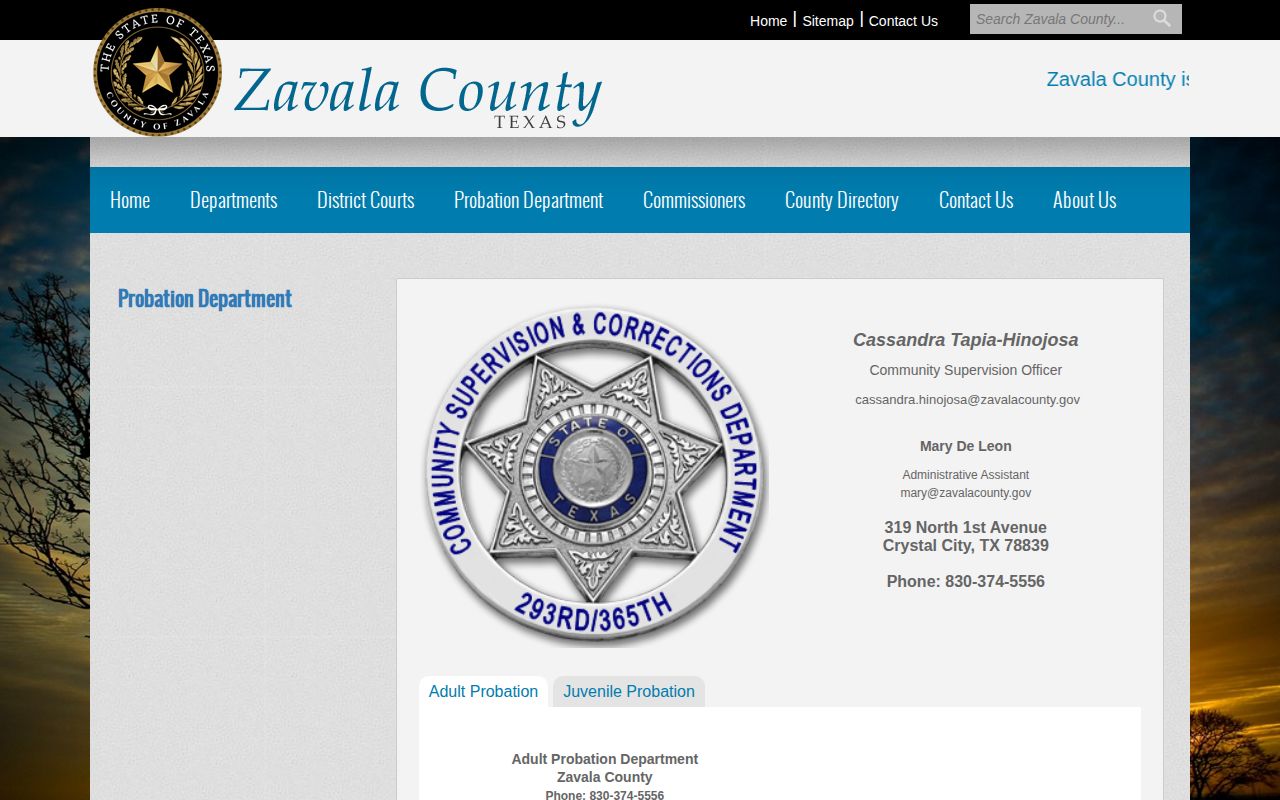
Use the office listing to route the inquiry, then rely on the case order or department record for the actual probation status.
Zavala Parole Conditions and Absconders
Supervision conditions are the rules in the release certificate or court order. They may govern reporting, travel, programs, or other case-specific duties, but no single public summary proves which conditions apply to one person. A violation allegation also does not itself show the final outcome. The supervising office and court or TDCJ record can distinguish a warning, modification, warrant, revocation process, return to custody, or later discharge.
TDCJ defines an absconder as a person on parole whose whereabouts are unknown after the person stops reporting. Its absconder information page provides a 24-hour anonymous tip line at 866-680-6667. That page is not a complete public warrant database. Absence from it does not prove compliance or prove there is no warrant. Questions about an active status belong with the responsible supervision or law-enforcement office.
- Parole
- Conditional release from state imprisonment under TDCJ supervision.
- Mandatory supervision
- A form of release from state imprisonment governed by eligibility rules and, for many cases, panel review.
- Community supervision
- The Texas term for probation imposed by a court and managed through a local department.
- Absconder
- A parolee who stops reporting and whose location is unknown to supervision staff.
- Discharge
- The formal end of a custodial sentence or supervision term, shown by the responsible agency's record.
Zavala Supervision Discharge Records
Supervision ends through an official event, not through silence from a search page. For probation, the strongest evidence is the court docket and the order that completes, modifies, or revokes community supervision. For parole or mandatory supervision, seek TDCJ incarceration and release history, the release certificate, parole-office confirmation, and any discharge record. A person may fully discharge a sentence and have no active parole office relationship afterward.
Texas Government Code Chapter 508 governs parole and mandatory supervision. Its rules depend on the offense, offense date, sentence, and eligibility category. Do not reduce every case to a single fraction or expected date. Likewise, an old TDCJ search result that later disappears only shows that the person is outside the live search's current-incarceration scope. It does not supply the release type or date.
A records request should ask for existing documents, not an office's legal conclusion. State the full name, TDCJ or SID number if known, conviction county and court, and the approximate date range. Request the release or discharge history and the record that identifies parole, mandatory supervision, discharge, or transfer. For probation, use the cause number and ask the clerk for the judgment, supervision order, later modifications, revocation papers, and discharge order as applicable.
Note: A court disposition explains legal authority, while the custody agency documents the physical departure and the supervision office documents reporting status.
Property Records After Zavala Release
Release closeout can leave a second useful paper trail. The Texas Local Schedule PS keeps county jail property inventories and receipts through release or transfer plus two years. A signed property-return receipt may support the date on which a Zavala County booking was closed and help resolve a dispute about personal items. It does not state why custody ended and cannot establish parole, probation, or discharge on its own.
Ask for the property inventory and return receipt as existing records alongside the booking-and-release sheet, release or transfer order, and jail-register entry. Match all documents by the same booking number. If the release record shows a transfer to TDCJ or another agency, the property receipt confirms local closeout but not arrival or later release from the receiving system. That next event must be verified with its own custodian.
Which Zavala Supervision Office Handles It
The office split is one of the most useful Zavala County facts. Del Rio DPO handles TDCJ parole and mandatory supervision assigned for Zavala. The Crystal City Adult Probation Department handles community supervision ordered by a Zavala court. The Zavala County Jail confirms its own release or transfer event, but it does not supervise state parole. Court clerks preserve the judgment and orders, but they do not replace the supervision office's current status record.
The TDCJ Region IV listing is the official source for the Del Rio assignment. Its captured office page appears below.
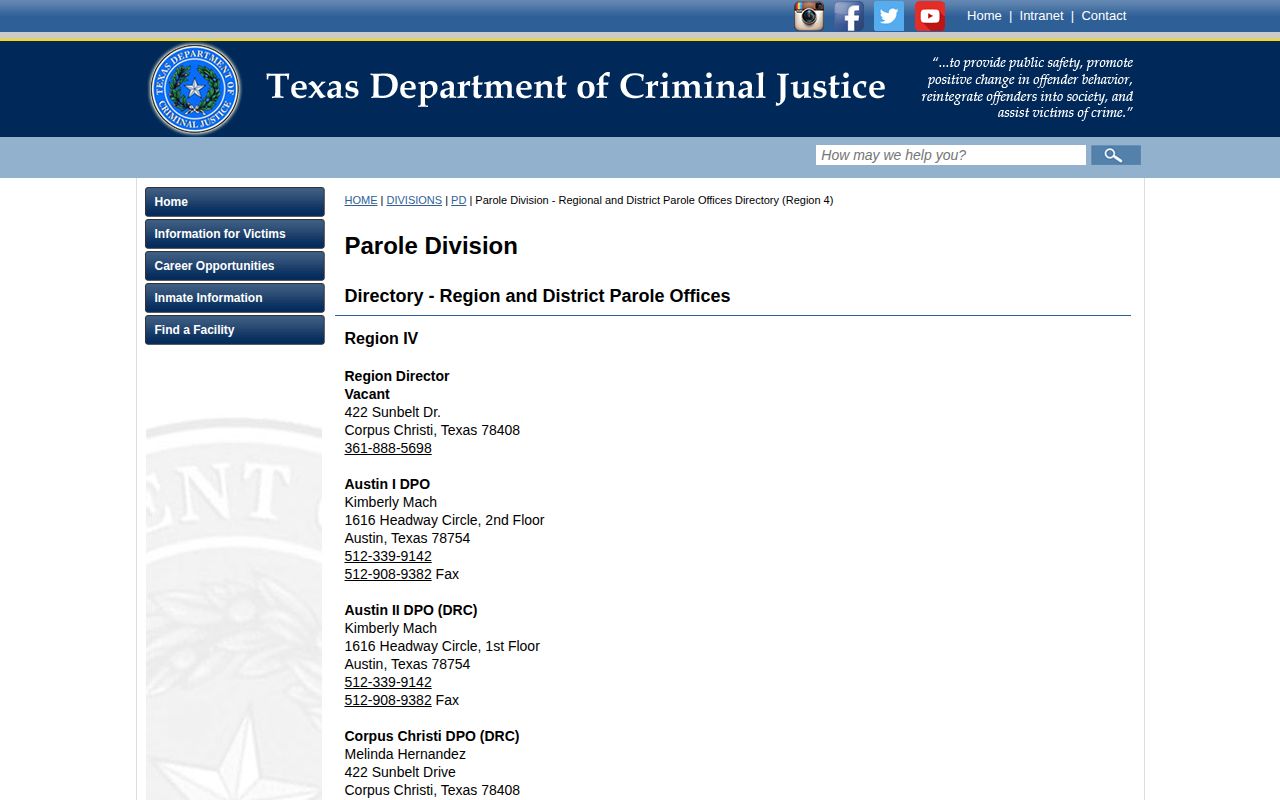
When the underlying event is uncertain, work backward from the last custodian. Confirm jail departure, read the court order, verify TDCJ release if state prison followed, and then contact the office tied to the resulting supervision type.